




A two-week trip to Japan at the most popular travel time: travel inexpensively and spontaneously to the cherry blossom season
Most of us associate a trip to Japan with far-off places, fascinating culture, the latest technology, but also with high prices and farsighted and timely planning. Travel to Japan is often already offered as an organized package tour, but the relatively high prices tend to deter many, especially younger people. How many times have I heard:
"Unfortunately, I can't afford a trip to Japan."
But a trip to Japan doesn't have to remain just a dream. Most travel guides and blogs recommend starting to organize and plan your Japan trip at least three months before your intended travel dates.
- A two-week trip to Japan at the most popular travel time: travel inexpensively and spontaneously to the cherry blossom season
- Compare flight prices & accommodation and choose a realistic itinerary
- Our 2 week itinerary for Japan looked like this
- Hotel prices in Japan: Cherry blossom season is not always the same as cherry blossom season
- The Japan Rail Pass: How to get from A to B in Japan
- Total cost for 2 weeks Japan peak season (cherry blossom)
- Food in Japan: Huge selection for every budget
Especially during the cherry blossom season, which is considered the absolute high season in Japan, you would have to take care of accommodation and flights as early as possible. That's all true, because the earlier you start, the more choice you have and the more you can save, but I'll tell you how I managed to do a two-week trip to Japan in just a few weeks (three in total). to organize the most popular travel time. And no, I didn't sleep under a bridge or share my room with strangers in a hostel. Quite the opposite. During my entire trip I was accommodated in comfortable and very central business hotels. So it's all a question of organization and the Internet.
Today I will show you how you too can set up an individual trip to Japan with a little research and just a few clicks in the shortest possible time, because it is easier than you think.

Compare flight prices & accommodation and choose a realistic itinerary
The first step is: Dare to do it! Dare to fight for your dreams and do your research instead of saying from the outset, "I can't afford that anyway!" Instead, look for ways HOW you can afford it anyway. With the internet, countless paths are open to us these days; we just have to take them. So, first of all: Don't despair, just start. The very first thing I did was get an overview of current flight prices and accommodations. Then I looked for possible and realistic itineraries that could be completed within two weeks. I quickly found what I was looking for and can wholeheartedly recommend the following blogs if you are interested in Japan or are even already planning a trip there: Suitcaseandwanderlust and Wanderweib.
After putting together a rough itinerary, I started comparing flights . I usually use Skyscanner and Kayak for this. They allow you to conveniently view flight availability for your desired destination for an entire month. This is very practical and allows you to find the perfect flight, depending on your flexibility. Flight prices vary considerably and can change even hourly, so monitoring the market is a good option. I had already looked at flights to Japan months in advance, and they were significantly more expensive then than just a few weeks before my planned departure. While earlier isn't always better, if you're already considering a trip, it's still worth checking and comparing as early as possible. This way, you can see if any new flights are added or if prices drop. I even found a direct flight with Japan Airlines for under €700 this way.
With a bit of luck, however, you can get direct flights for less than €600. After the flight had been booked and possible accommodation had already been noted, it was time for further planning. Step by step we booked the accommodations in the respective places we wanted to explore.
Our 2 week itinerary for Japan looked like this
- Day 1: Arrival Tokyo
- Day 2: Continue to Fujiyoshida
- Day 3-4: Stop in Fujiyoshida and Kawaguchiko with traditional onsen
- Day 5: Drive to Kyoto
- Day 6-9: Stay in Kyoto
- Day 9: Return to Tokyo with a connection in Yokohama
- Day 10-14: Stay in Tokyo
- Day 14: Flight back to Germany

Hotel prices in Japan: Cherry blossom season is not always the same as cherry blossom season
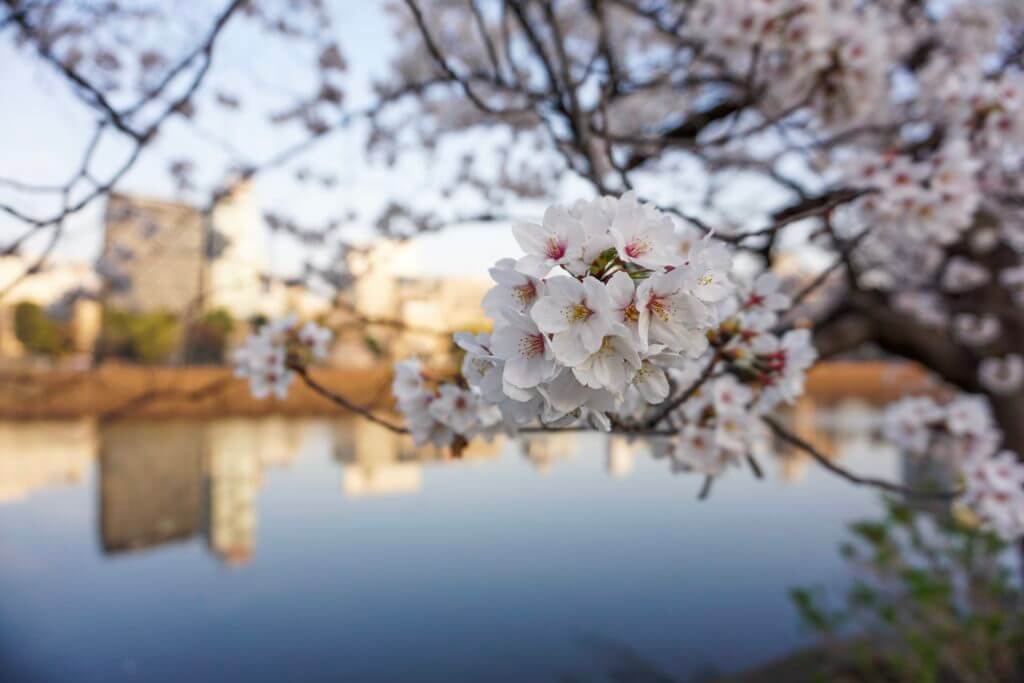
We booked a total of four accommodations and were surprised by the moderate prices. There was still a relatively wide selection of comfortable and centrally located hotels for between €80 and €120 per night (some including breakfast). But these are already "cherry blossom prices," because if you travel at a different time of year, you can find clean, beautiful hotels right in the heart of Tokyo for as little as €30 per night, including breakfast! I haven't seen such prices even in more rural areas of Germany. And cherry blossom season isn't a single, uniform time, as the cherry blossoms bloom at different times in Japan depending on the region.
You can admire them as early as January on the sunny island of Okinawa, while in northern Hokkaido they don't appear until May. This means you don't necessarily have to travel to Japan in mid- or late March to see the cherry blossoms, as they actually bloom a bit later in the north, allowing travelers to benefit from significantly lower prices. Hotel rooms in Japan are generally very, very small unless you book a luxury room. But don't let the limited square footage put you off, as the rooms are generally extremely comfortable and meticulously designed down to the smallest detail. I find it particularly charming and thoughtful that most accommodations provide pajamas. You can find a good overview of hotels on Trivago and TripAdvisor.
The Japan Rail Pass: How to get from A to B in Japan
Once you've arranged flights and accommodation, all that's missing is transportation to get you from A to B, and that's incredibly easy and straightforward in Japan. Japan has one of the best infrastructures in the world. The Japan Rail Pass is particularly recommended if you want to explore Japan by train or express train/Shinkansen. It is the easiest way to travel through Japan and is a very good way to get a first impression of the country. In addition, Japanese trains are extremely comfortable, modern and clean. With the Japan Railpass you can reach almost all major cities. However, before you decide on the Japan Rail Pass, you should first compare whether you can use it for your selected route and whether it is worthwhile for you. It is advisable to order it about a month before the start of your trip. It is valid for three months from the date of purchase.
The Japan Rail Pass allows unlimited use of almost all Japan Railways Group (JR) trains throughout Japan. However, the pass is not valid on the Tokyo subway, the Kyoto bus network or the private lines (Kintetsu). The pass is usually worthwhile for longer distances between larger cities. If you would like to find out more about the Japan Rail Pass and where you can purchase it, you can find detailed information in my next blog post "With the Japan Rail Pass cheap and comfortable through Japan".

Total cost for 2 weeks Japan peak season (cherry blossom)
And so nothing stands in the way of a trip to Japan! For around €1500 per person you get 14 days in Japan with flights, accommodation (some including breakfast) and the Japan Rail Pass for one week. Of course, there are still no expenses for food, subway and sights, but I can reassure you there too: Many of the sights are completely free or only cost a few yen and there is food on every corner.
Food in Japan: Huge selection for every budget
I've never seen as much food in any other country as I did in Japan. What surprised me most, however, were the prices. Of course, it depends on your expectations and whether you're in Tokyo or more rural areas, but in the major cities, you can get a delicious, fresh meal for as little as €3,50. You can even buy fresh, hot meals in supermarkets. No one will go hungry here. Quite the opposite, in fact. On no other trip have I eaten so often and so well as in Japan, and at comparatively very reasonable prices. Especially at the markets, you can sample local dishes and specialties. In the big cities, you'll find a restaurant or food stall every few (very few) meters. Food is simply a big deal in Japan – which is why I wrote a comprehensive article, " Dining in Japan: My Top 7 Favorite Japanese Dishes You Absolutely Must Try ," because perhaps some of you have already noticed: I LOVE FOOD.
So you see, even if a trip to Japan is still not a Mallorca bargain (Japan and Germany are a whole 9.043 km (!) apart), it is still possible to travel comparatively cheaply and, above all, to visit the country in high quality and comfortably explore and thus realize his long-awaited dream of the land of the rising sun.


A very nice article! I find the point about the cherry blossoms particularly interesting; that way, one could actually avoid the large tourist crowds that are sure to be there in mid-March. I'd also be interested to know what food you would recommend in Japan; perhaps you had a few highlights? 🙂 Many warm greetings from Silvia at http://www.abenteuerzeilen.de
Hello dear Sylvia,
Thank you very much for your comment. What I find particularly tasty are the soba noodles, takoyaki (which you can get almost everywhere to go), and okonomiyaki.
But there is much more. I recommend trying it out properly and being surprised by the taste 🙂 I especially liked the many matcha sweets, for example. But there will soon be a detailed article on the subject of "Food in Japan", also with tips for vegetarians 😉
Regards
Lina
A beautiful article! Thank you very much for recommending my blog 🙂
dear Nicola,
I liked doing it 🙂 because your blog is really great and very helpful.
Kind regards
Lina